Yes, I know I typed the title incorrectly. But too often, I hit myself because I have way too many typos. One is even too many. Do I have a psychological problem that needs therapy. Well, I mean in spite of all the other issues that need to be worked out before I get to the issue of spelling errors and bad grammar.
I am not unschooled. I am quite aware of this shortcoming in my writing style. I often write more like a dialogue and less like a paper. This didn’t help when I was writing papers in all those years of education.
Examples of me catching myself, after the fact, in my writing experience …
- In high school, one of my first papers to my hardest English instructors received a -275 (yes, a negative.) Apparently, in the essay, my first verb was past tense and the remainder of the paper, in its entirety, was in present tense. So she marked ALL the 300+ verbs wrong. Not the first one, which was part of a sentence I added in after the rest of the paper was completed. She marked the rest wrong. I could correct the errors and resubmit for a revised grade; but still, this left me with a -80.
- My Thesis was typed, checked, re-checked, proofed by a professional, read by the Thesis Committee … and no errors were discovered in the final edition. Yet, months later, when I reread it (I had trouble sleeping and it normally puts most readers right to sleep) … when I reread it, two blatant errors popped out.
- I’ve written wrong names as I wrote out a funeral eulogy and wedding vows – ughh – Even read them wrong at the services.
- And there are countless others, but these keep me up at night.
And then the blog, the newsletters, the emails, the texting … and it is amazing how many love to point out the ‘errors.’ I once read that the editor of the Saturday Evening Post declared they intentionally leave at least three errors in each issue for those that live to find (and report) other people’s mess ups.
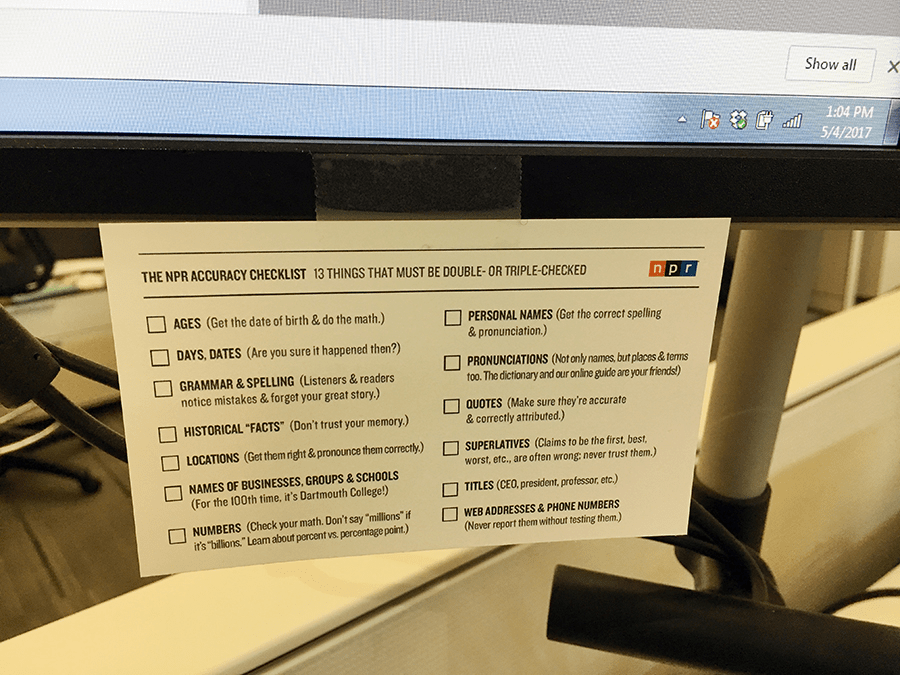
NPR has an article that gives six tips for catching errors …
- Reread it. My father used to read his from end to start, trying to discover errors from a different point of view.
- Change the format. This helps to change your memory and prevent the impact of skimming from familiarity.
- Step away. Take a break. Purge your mental palette. Then reread again.
- Use spellcheck and grammar check. These are definitely my friend. Though at times, I think they are picking on me.
- Use a check list. If there are common errors and must-check items, keep a list of these and be on the lookout
- Recheck the important stuff. Names, citations, first paragraph, closing paragraph, etc.
I would add, have another person check it. Remember, people will judge you on your work. Sloppy editing makes sloppy impressions.
But I am more concerned with the why. Am I ignorant or overly careless?
Not necessarily. The things many people write are often high levels of thinking with something important that they hope to get across. Therefore, by focusing on big concepts and complex systems, communicators often generalize and skip focus on details like spelling and individual words. Then, when proofreading, we read what we think we want one to write versus what we actually say. UGHH. Slowing down doesn’t always help. It’s discipline.
And when we push, “SEND” or publish … our brain changes to a different role from creator to reader. And then – UGHH – Typos. (I love the iPhone lets you edit sent text, for I am a monster on my fat thumbs typing unforeseen nightmares.)
So use the tips, but also discipline yourself to read from a clear mind, not one of familiarity.
Also … don’t take criticism too harshly. Just tell the one judging that you were thinking on a higher plane.
The photo and six tips come from the NPR article by Amy Morgan.
The article included a quiz, and we all love quizzes. Find the errors …
Before he was Ivan Drago, Hee-Man or an “Expendable”, Dolf Lundgren was just another six-foot-five Norwegian male model with a black-belt in Karate and a degreee in chemical engineering.
Corrected version:
Before he was Ivan Drago, He-Man or an “Expendable,” Dolph Lundgren was just another 6-foot-5 Swedish male model with a black belt in karate and a degree in chemical engineering.
 Muddy Shoes by Todd
Leave a comment